
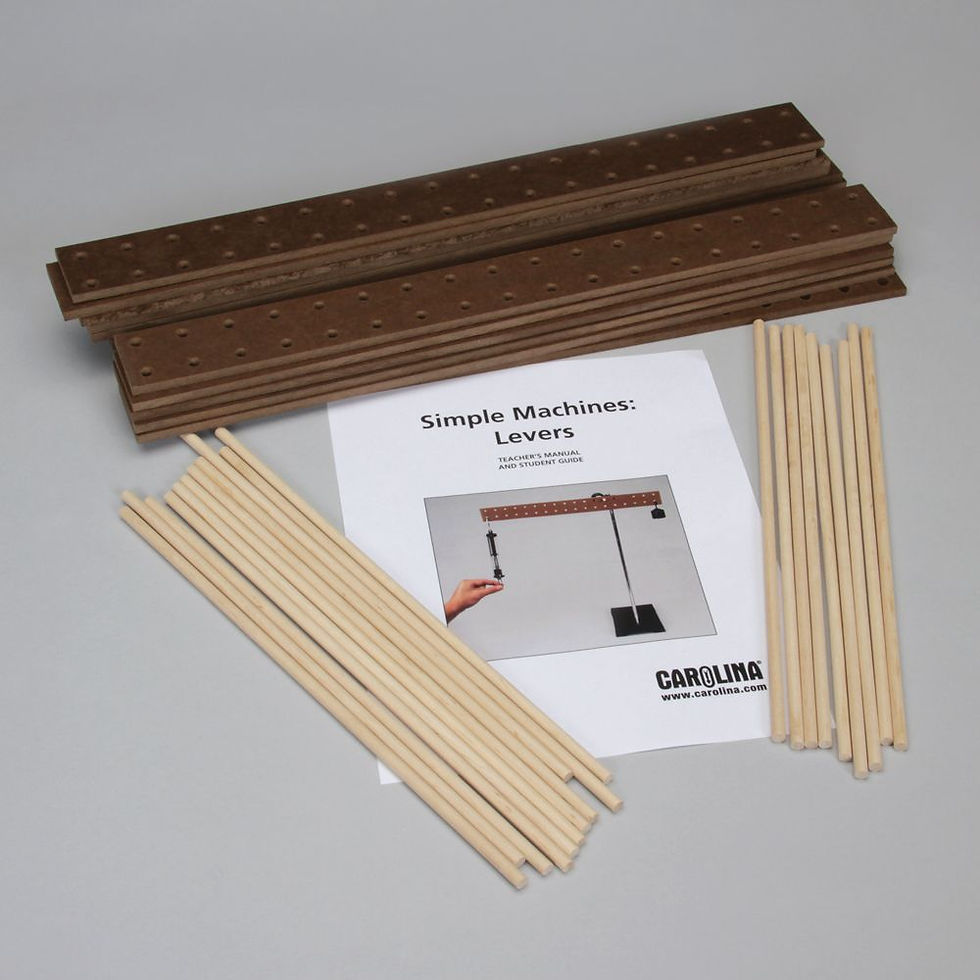

Grades 6–12. Students learn there are more to levers than just seesaws and scissors as they explore first-, second- and third-class levers. This kit is a great introduction to the world of simple machines.
Lesson objectives:
- Observe the mechanical advantage of a lever.
- Calculate the mechanical advantage, ideal mechanical advantage, and percent efficiency of 4 different levers.
- Classify levers as first-, second-, or third-class.
Extend this lesson by having students:
- Measure the effort distance and resistance distance, to compare the work input to the work output
- Use force sensors and graphing software for data collection and analysis
- Create picture collages of levers encountered in everyday life (home, playgrounds, schools, sports fields, etc.), which incorporates art into the lesson (STEAM)
Teach the fundamentals of levers, a simple machine we encounter in our everyday lives. Students construct first-, second-, and third-class levers; measure the force needed to lift a load for each class; then calculate the mechanical advantage and efficiency of each. Kit includes instructions and levers for 15 student pairs. Needed but not supplied for each pair: spring scale, meter stick, 200-g hanging mass, and ring stand and clamp.
Carolina® Simple Machines: Levers Kit
SKU: 751342NC


